
Monday, April 13, 2015
The Importance of Positioning in Marketing
In this video I speak about how to position yourself or your business as an expert/authority. I hope you enjoy it!

Tuesday, April 7, 2015
What Google's New Mobile-Friendly Changes Mean for You

On February 26, Google dropped a major bomb in a seemingly-casual blog post on mobile-friendly search results. While the engine has always made mobile-readiness and the easy access of information a priority, it has now spelled out that it will use mobile-friendliness as a stronger ranking signal than ever before. It will also increase the presence of relevant app content in the search results.
So what does that mean for you? Basically, if you’ve been holding out on implementing a mobile strategy for your business website, it’s time to make this a top priority. Here’s how to do it.
Check your site’s mobile-friendliness
Google has made it easy to take the first step toward determining whether your site is set to take advantage of these new changes with its Mobile-Friendly Test. Simply open the page, enter your URL and click “Analyze.”
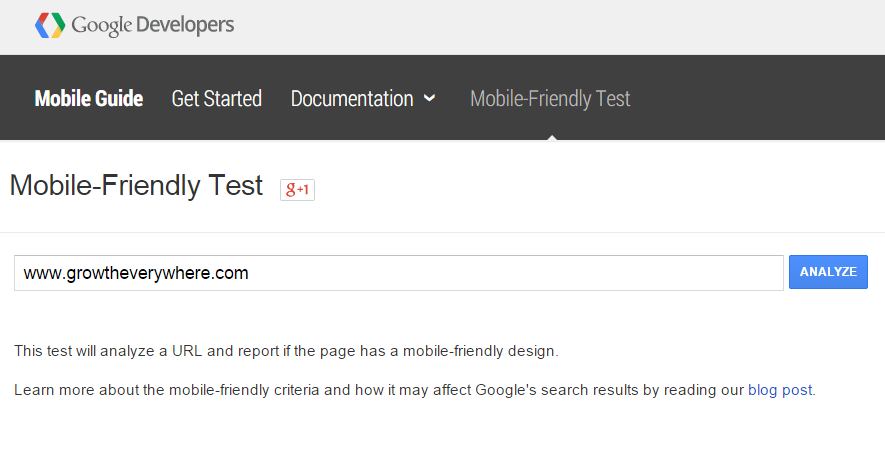
Google will then check your site and report whether or not it’s mobile-friendly. If your site qualifies, the tool will also return a screenshot of how your site currently appears on mobile devices.
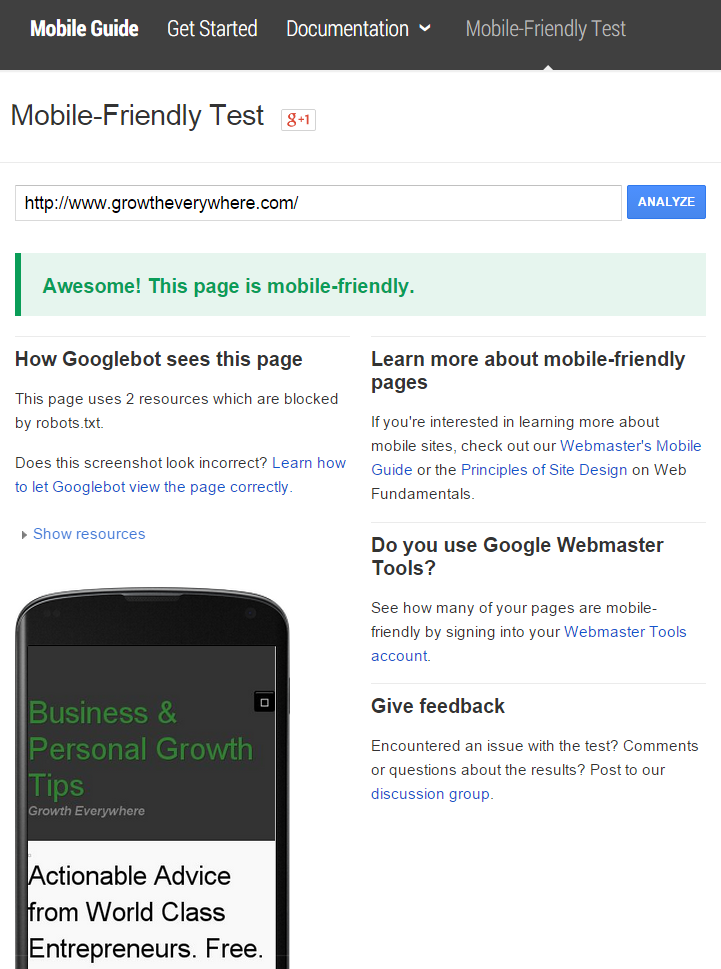
If your site ranks as mobile-friendly, you’re in good shape, though you’ll still want to read through the following recommendations. Just because your current design passes Google’s test doesn’t mean that there aren’t still ways for you to improve or things you’ll want to watch out for if you go through a website redesign in the future.
Fixing mobile-friendliness issues
If your site fails Google’s mobile-friendliness test, the program will report the specific issues that led to this determination.
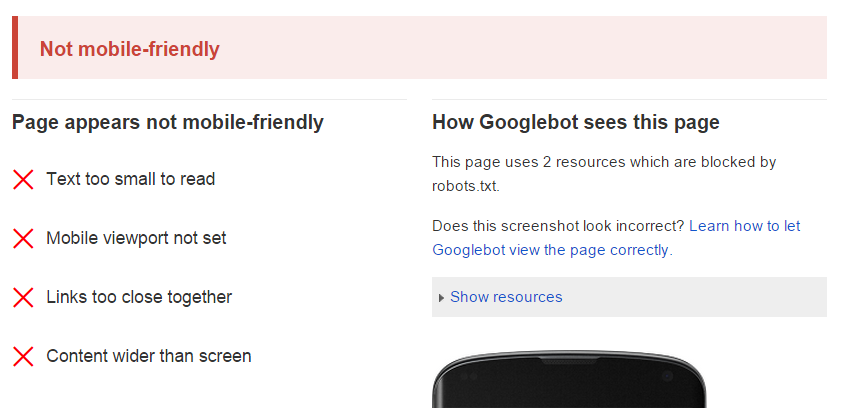
These recommendations will give you a starting place for the changes you’ll want to make to bring your site into compliance. Google also offers a helpful guide to getting started with mobile-friendly websites you can reference to help resolve these issues.
However, be aware that the issues Google reports may not be the only factors influencing your website’s mobile usability. For that reason, it’s a good idea to explore all of the following steps to ensure your mobile visitors are as comfortable on your site as your desktop users.
1. Is my site responsive?
In the past, website developers had several options to create a mobile site version, including custom coding a separate mobile site, deploying device-specific HTML sites based on the vary HTTP header tag, or using a responsive design that automatically adjusted to account for various device sizes.
Today, though, there are simply too many different device shapes and sizes for a single static mobile site to fit comfortably on all potential screens. Google’s official recommendation is now to use a responsive website design. Your developer or designer can tell you if your site uses this protocol. Or, if your mobile-friendliness test reports that your mobile viewport is not set (as above) or uses a fixed-width, there’s a good chance your site is not responsive and should be fixed ASAP.
2. Are scripts or other services interfering with my site’s usability?
If your desktop site makes use of pop-up lightbox scripts, exit intent banners or other similar types of technology, it’s critical that you ensure these programs are able to accommodate mobile users. There’s simply nothing more frustrating than having a banner pop up across your mobile web browser and being unable to close it.
At the same time, be sure that your site avoids the use of file types like Flash that either don’t display at all or display incorrectly on some mobile sites. Google’s priority is to get people the information they want, as quickly as possible -- and they can’t do that if your files are too difficult to load.
3. How easy is it to navigate my mobile site?
In addition, remember that what looks good on your desktop website may not work as well on a mobile device. Keep all of the following considerations in mind as you evaluate your site’s mobile-friendliness.
- Make sure any tap targets are at least 48 CSS pixels tall/wide, and that you have at least 32 CSS pixels of both vertical and horizontal spacing between each tap target. Doing so will prevent inadvertent wrong-page clicks that can frustrate users.
- Use a base font with a size of at least 16 CSS pixels. Keep the number of fonts used to a minimum and maintain appropriate vertical spacing between rows of text.
- Adjust any graphic elements on your site that are currently using a fixed width formatting, as this will prevent your content -- even when part of a responsive site design -- from sizing appropriately for the viewport.
Finally, even if you think you’ve set up everything perfectly, test, test and test some more. Use mobile site emulators to view your website in different sizes and layouts. Ask friends and family members to navigate from their digital devices, or invest in paid user testing that’ll record the actions and reactions of anonymous visitors to your mobile site.
It may sound like a lot of work to guarantee mobile-friendliness, but it’s a vital part of keeping your visitors happy and maintaining your site’s search visibility.
Monday, March 23, 2015
Steve Jobs: Secrets of Life
Steve jobs explaining why we need to believe that we can change things if we really want to.
Remember if you die having made enemies, then you probably stood for something.
What do you stand for?
2 Key Lessons in Brand Building

College students say the darndest things. In a recent marketing class, our discussion turned to McDonald’s unique TV ad, “Signs,” which features shots of the iconic golden arches, each with a customized message on its placard:
- Thank you Veterans
- We Remember 9/11
- Boston Strong
- Hug Those Dads
“I think the ad is great,” a student in the classroom's front row said. He explained how he really liked the ad’s theme and positive emotion. What he said next, however, washed away all the brand equity: “But I still hate McDonald's.” Much of the class nodded in agreement.
It’s not fair to judge a firm’s success on a single set of reactions to one ad. Still, the students’ collective response to the commercial and to the McDonald’s brand is very telling. For every organization seeking to build or restore its brand, there are at least two valuable lessons here to be learned:
Related: The Basics of Branding
1. Actions speak louder than words.
There’s a reason why the phrase “talk is cheap” resonates with us. We know it's much easier to say things rather than back up those words with appropriate action. Whether on the basketball court or in the boardroom, our tendency is to discount the “talkers” and respect the “producers.”
Chipotle, which has been eating McDonald’s for lunch, provides a good example of the latter group. A leader in the fast-casual revolution, the Mexican grill joint does relatively little traditional advertising or talking. Instead, it lets its actions speak for it. The firm recently pulled pork from its menu because a key supplier couldn't comply with the company’s high standards for animal treatment. This significant subtraction from an already small menu had to hurt revenue, but the integrity underlying the action did much to bolster the brand.
2. Trouble can’t be turned around overnight.
Although we might forget within minutes the firm featured in our favorite Super Bowl ad, we have long memories about other things -- especially wrongs we’ve endured. Unfortunately, many people feel that fast food in general -- McDonald’s in particular -- has wronged them, and I don’t mean just health concerns. There’s also the growing notion that the food’s marginal quality isn't worth even its relatively low cost. While not an egregious one-time offense, the slow erosion of a firm’s value proposition is just as harmful.
When a company breaks its main brand promise -- to provide its customers with true value, for instance -- it takes time and often far-reaching change to restore trust and win back allegiance. Apple knows this well. In the 1990s, when the company was on the ropes, rehired CEO Steve Jobs initiated a dynamic sequence of new product development, from iPods to iPhones to iPads. Each of these innovations was likely years in the making, and together they drove a brand transformation that took more than a decade. Of course, Apple’s tremendous success since, including its recognition as the world’s most valuable brand, has validated the firm’s considerable investment of time and resources.
For most brands, effective messaging is just the icing on the cake. Troubled brands usually have deep-rooted challenges (aka cake problems) that require more than just another layer of pretty frosting. More than simple words, the right corrective action and ample time are needed to fix a broken value proposition and restore a brand that consumers will again love.
Friday, March 13, 2015
5 Secrets to Succeed at Video Advertising

Video, if done right, is one of the most powerful storytelling formats in the world. Indeed, sight, sound and motion elicit great emotion. It has the power to make us laugh, to cry, to contemplate big ideas and call people to action. With video advertising expected to grow 21 percent annually, it has never been a better time to be a content creator.
Whether the intent is to entertain, inform or persuade, there are many things to consider before setting out to create your next video campaign.
Here are five ways to maximize a video initiative in order to make your video advertisement go further.
1. Go beyond the 15- and 30-second spots.
Everyone knows that consumers are migrating to a multi-screen world. As people spend more of their leisure time on digital devices, advertising dollars should follow the eyeballs. For marketers, you are no longer constrained to the formats of old standards that TV once held firm. By thinking outside the 15- and 30-second box, you can create rich and compelling stories for viewers that are emotional, memorable and impactful.
Digital browsing is usually done at leisure, which means that consumers have more time to engage with longer form videos that can be up to three minutes in length.
2. Compel your audience to an action.
Your video may be the bait but the call-to-action is the bite. When activating your video campaign, it’s important to identify how you want your audience to react for maximum ROI. Include a call to action at the end of your video that reminds the viewer to visit your site or subscribe to your channel. For a relatively low cost, you can also use companies like my business Virool to create custom banners and video overlays with one-click social sharing buttons.
3. Retarget in order to re-engage.
One of the biggest mistakes that marketers make is assuming that people will immediately make a purchase after watching their video. Think about it: When was the last time you did that yourself? Customers need a reminder across multiple touch points before they make a buying decision. Retargeting companies like AdRoll or Criteo can help re-engage your viewers by targeting them with banner ads down the line. Your video is the hook to get people excited about your product, but it will take a few reminders before they return to your site and make a purchase.
4. Use data to find an audience and place it programmatically.
There is an amazing amount of consumer data available on the web that can be leveraged to find your ideal audience. Make the most of your budget by combining three different types of data parties:
- First party: Also known as your data or the CRM data that you own
- Second party: Is someone else’s data, whether it is publisher data or data from the distribution platform that you partner with.
- Third party: These are like BlueKai or Nielsen, the behemoths of the data world.
If you package these together, you’ll be able to effectively target an audience with little to no waste. If you can understand who reacts to messages and under what circumstances, you can optimize your campaign and replicate your success with other like-minded consumers.
5. Video is hard but it is not impossible.
What good is a video if no one is seeing it? Be smart about your video and activate your campaign by partnering with a trusted company that can help you reach your audience across multiple publishers and platforms. Always identify your KPIs before you begin. Do you want more views, social engagement, a high click-through rate? Once your video is up and running, keep a close eye on the performance and pause it if you’re not happy with the results. There are many small adjustments that can be made to optimize the results and give you the most bang for your buck.
Thursday, March 12, 2015
To Have Your Video-Content Marketing Be Successful in 2015, Follow These 5 Rules
Some things just belong together. Shoes and socks. Bees and honey. Peanut butter and jelly. Videos and advertising. Whether they’re instructional, informational, or simply for fun, videos are an important part of today’s marketing strategy.
According to a recent report sponsored by Demand Metric and VidYard, almost 70 percent of marketers use video as part of their marketing strategy and 82 percent say they’ve seen success with video content marketing initiatives. If you’re planning to give video a larger place in your content marketing strategy for the coming year, here are a few things to keep in mind.
1. Define your goals.
Videos within the context of content marketing mean different things to different people. If the marketing team whips together a video highlighting features of a new product while the CEO is expecting something that depicts a day in the life of a company employee, that’s an expensive lesson to learn. Make sure everyone is on the same page before the cameras roll.
Part of clarifying the goals of your video content marketing strategy should be to determine how your team defines successful metrics. By the number of viewers? How often it’s shared? How many leads it generates? If it goes viral? And, what constitutes “viral?” Figuring out these kinds of things ahead of time helps you spot what’s working and what need to be tweaked.
2. Star or supporting cast?
Give some thought to what kind of role you want your videos to have as part of your overall marketing strategy: central or peripheral.
For some organizations, casting video in the starring role makes the most sense. The majority of camera manufacturer GoPro’s marketing content revolves around videos, with social media content, blog posts, and other types of advertising serving as support or collateral content. The company now boasts 2.5 million subscribers to its YouTube channel and was the platform’s top brand channel from January to March of this year.
Some products or services simply don’t lend themselves to that much of a focus on video marketing, but that’s okay. Videos that supplement a company’s primary marketing content are still important and useful. Even a collection of videos showing how to repair or troubleshoot a product can be positioned to customers as a value added benefit.
3. Remember to include a CTA.
Obviously, you’ll want each video you create to feature your logo and brand but it should also include a clear call to action (CTA). Written copy allows content creators to easily incorporate clickable buttons or URLs but videos present a bit more of a challenge. Incorporate your CTA directly into the video both visually and audibly for the best impact.
If you share your videos on YouTube make sure to use the platform’s Annotation feature to add pop-up messages that automatically play whenever your video is viewed. Don’t rely on it exclusively for your calls to action, however, because YouTube allows its users to disable pop-ups if they choose.
4. Paid or organic distribution?
There are two ways to get your videos noticed: pay to have them distributed or let customers find it themselves. What’s the best approach? A mix of both.
Organic reach on Facebook has been taking a nosedive for a while now. Facebook VP Brian Boland says it’s due to a combination of factors including the way its algorithms are structured and that there’s simply “far more content being made than there is time to absorb it.”
Facebook hasn’t reported any plans to increase organic reach and now Twitter is hinting at taking a similar approach to how they serve content to users. All the major social media platforms offer tools to help brands boost their signal — in exchange for fee, of course.
If you want a fighting chance at getting your videos seen on social media, you’ll need to spend a portion of your marketing budget on buying promoted or boosted ad space. It’s money well spent, though, and you’ll be in good company, to boot. A 2012 Nielsen survey revealed that 65 percent of marketers increased their social media ad budgets for 2013.
Of course, paying for reach doesn’t mean you can take the rest of the week off. You still need to promote your video content via your own social networking channels and email campaigns.. Videos are the perfect medium for cross-channel distribution so don’t forget to use them at trade shows, as part of your online user support tools, or in mobile apps you create.
5. Find a parking spot.
Your videos need a permanent home on your website so you’ll want to find the best place to put them. Vimeo, Brightcove, YouTube, and other video hosting sites are an option. However, they might not be your best choice if you want to retain complete control over your content and what ads (if any) are shown alongside it. Housing your video in an on-site content management system is a better bet. From there you can set up on other distribution channels and add your videos there as well.
Wednesday, March 11, 2015
Here Is How to Get Your Branded Video Watched - Part 2
Continued from Part 1.....................


Add to these videos the fact that Tumblr enables brands to disseminate content throughout the Yahoo family and a powerful communication mechanism emerges. Other media companies are identifying powerful social media storylines on platforms such as YouTube and selling robust media packages around them. In an interview with Streaming Media, Danny Fishman of digital entertainment company Believe Entertainment Group describes the keys to successful video branding.
“For us, it’s more about going to where the current fan base exists versus trying to bring them elsewhere,” Fishman explains.
“For us, it’s more about going to where the current fan base exists versus trying to bring them elsewhere,” Fishman explains.
On a final note, Instagram also has tested the waters of the branded video space—specifically for mobile devices. The concept: create a series of 15-second video episodes around product reviews and other actionable information, the media and events company Tech Cocktail notes.
These creative solutions are just some of the ideas your brand might try to get social and achieve measurable returns. (Hey, if banks are already doing it, you should probably get in the director’s chair sooner rather than later.)
Explore the up-and-comers
Up till now, we’ve touched on mostly familiar channels. Yet the startup community is buzzing with interesting ideas surrounding branded video, from interactive elements to adjustable native ad displays. Consider the following two examples:
Rockabox creates a website-style experience that is anchored by video, explains an article from VideoAdNews.com. Interactive elements are key, with clickable content online visitors can use to navigate to additional information and social sharing, among other features. Yet the system isn’t simply about grinding out yet another painful video ad. “Consumer engagement won’t start to happen unless the right creative idea is delivered,” CEO James Booth tells the news website.
Sharethrough is built around an in-feed exchange of content including videos, which are used to generate revenue. “Whereas Facebook’s exchange (FBX) is built for in-feed, native ads just on Facebook, Sharethrough’s Exchange (STX) is built to scale native ads in the feeds of content publishers across the rest of the Web,” explains CEO Dan Greenberg in an interview with AdExchanger.
There are plenty of other great resources for tracking emerging channels for branded video, including this cost-per-click breakdown by Contently.
Do your homework
The final point we’ll make here is to keep reading and learning. Branded video distribution goes beyond content creation and interaction to more profound issues such as copyright protection. That’s why companies such as Adobe have developed specialized products that essentially help you protect ownership in the original artwork and messaging you’ve invested in.
Clearly, we’re awash in an ocean of online video, and the tide is rising. Branded content is popular, and the best original ideas can find an enormous audience. Whether your creative rises to the surface will depend on whether you are nimble enough to ride these waves of change.
Subscribe to:
Posts (Atom)